


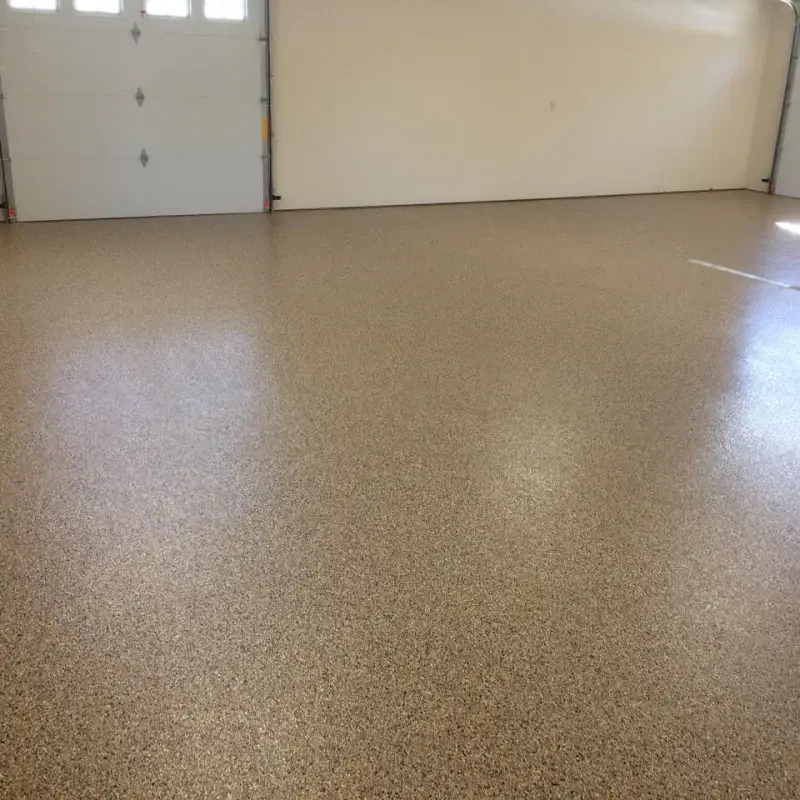
Epoxy flooring is often discussed as though it were a single product, but in practice it is a family of resin systems whose performance depends on chemistry, substrate condition, film build, and service environment. That distinction matters in garages, industrial workshops, commercial kitchens, breweries, wineries, dairies, and meat processing plants, where failures rarely come from the coating alone; they usually originate in moisture vapor, poor surface preparation, incorrect resin selection, or unrealistic expectations about what a decorative coating can survive. This analysis focuses on the engineering behind garage epoxy floors and adjacent high-performance applications, with particular attention to why some epoxy coated garage floors last a decade or more while others fail within months.
For readers already familiar with epoxy floor coatings, the unique angle here is the systems view: how primers, body coats, topcoats, aggregates, and substrate testing work together; how local conditions such as Sydney humidity and slab age affect adhesion; and why the same chemistry that performs brilliantly in a residential garage may be unsuitable for a commercial kitchen floor or brewery floor unless the build is redesigned. The practical goal is not just to choose epoxy flooring, but to specify the right epoxy flooring contractor near me, or the right epoxy flooring contractor in Sydney, for the actual duty cycle of the space.
What makes epoxy flooring technically distinct
Epoxy flooring is a thermoset polymer system formed by the reaction of epoxy resin with a curing agent, typically an amine, amidoamine, or modified cycloaliphatic hardener. Once cured, the coating forms a crosslinked network with strong adhesion to prepared concrete and excellent resistance to abrasion, oil, salts, many alkalis, and a wide range of cleaning agents. In contrast to garage floor paint, which is often an acrylic or single-component coating with limited chemical and mechanical resistance, true garage floor epoxy coatings develop a much denser film and a far more durable bond to the substrate.
In commercial and industrial contexts, the performance envelope expands further. Novolac epoxies offer improved chemical resistance for solvents and acids, while high-build systems and self-leveling mortars can correct surface irregularity and support forklift traffic. For commercial kitchen flooring, floor for commercial kitchen applications often require a seamless, hygienic, coving-compatible finish with slip resistance under wet and greasy conditions. In brewery flooring, winery flooring, dairy flooring, and meat processing environments, resistance to thermal shock, frequent washdown, and aggressive cleaning chemistry becomes as important as abrasion resistance.
Epoxy floor coating versus epoxy floor paint versus epoxy floor kit
These terms are frequently used interchangeably in consumer search, but they describe different realities. A garage epoxy floor kit may be suitable for a lightly used residential garage if the concrete is sound, dry, and mechanically profiled. However, kit formulations often optimize ease of application rather than long-term durability. Garage epoxy floor paint and garage epoxy floor painting typically refer to thinner, less robust systems that can improve appearance but are not engineered for heavy hot-tire pickup, fuel exposure, or repeated jack stand loading.
By contrast, epoxy floor coating and epoxy flooring garage systems usually imply a professional-grade, multi-layer specification with defined primer, broadcast, and topcoat steps. The best epoxy flooring contractors near me will not simply roll on a single coat; they will verify slab moisture, repair cracks, grind or shot blast the surface, and match the chemistry to the environment.
Substrate preparation: the real determinant of success
Industry practice consistently shows that most coating failures are substrate-related. Adhesion loss, blistering, and delamination are commonly linked to inadequate profile, contamination, or moisture vapor transmission rather than poor resin chemistry. Concrete is not a passive base; it is a porous, variable material with capillaries, laitance, microcracks, and sometimes curing compounds or sealers that can interfere with bond.
Advanced preparation checkpoints
- Mechanical profiling: Diamond grinding or shot blasting to an appropriate CSP level, often in the CSP 2-4 range for typical garage epoxy floor coating work and higher for thick self-leveling systems.
- Moisture testing: Relative humidity probes, calcium chloride tests, or manufacturer-approved moisture vapor emission assessments before priming.
- Contamination removal: Degreasing, oil extraction, and removal of curing compounds, sealers, and old garage floor paint.
- Crack treatment: Chase, clean, and repair active or dormant cracks with low-viscosity epoxy or polyurea fillers.
- Joint strategy: Honor control joints where required; do not bridge moving joints with rigid epoxy unless the system is designed for it.
In humid climates such as Sydney, and in coastal environments more broadly, the moisture risk is not hypothetical. A slab that appears dry at the surface can still emit vapor through capillaries, causing osmotic blistering or adhesion loss under an impermeable epoxy coating garage floor system. For this reason, experienced Sydney epoxy flooring contractors often specify moisture-tolerant primers or vapor barriers when slab testing indicates elevated risk. Searching for epoxy flooring Sydney, Syd epoxy flooring, or epoxy floor Sydney should therefore be less about proximity and more about whether the contractor understands moisture remediation, not just decorative application.
Chemistry, thickness, and performance trade-offs
The choice of resin is an engineering decision. Standard bisphenol-A epoxies are versatile and economical, but they may yellow under UV exposure and can be brittle if formulated for high hardness without sufficient flexibility. Cycloaliphatic systems improve color stability, while novolac epoxies improve chemical resistance in acid-heavy or solvent-heavy environments. For epoxy resin flooring and resin flooring contractors, the selection must reflect traffic type, cleaning regime, and temperature fluctuations.
Film thickness matters as much as resin type. A thin decorative coating can look excellent yet wear prematurely under point loads and hot tires. A high-build epoxy flooring contractor may recommend one of several architectures:
- Primer + topcoat system: Cost-effective for low-to-moderate service garages.
- Broadcast system: Quartz or vinyl flake broadcast into a wet body coat for improved traction and hiding.
- Self-leveling mortar: Used where substrate correction, impact resistance, or heavy-duty service is required.
- Epoxy with polyurethane or polyaspartic topcoat: Improves UV stability and can accelerate return-to-service times.
For garage floor coatings exposed to vehicle fluids, brake cleaner, coolant, and road salts, a robust broadcast system often outperforms a smooth glossy finish because the aggregate improves wear distribution and slip resistance. However, a smoother finish may be preferable where rolling loads and easy cleaning dominate, such as in certain garage epoxy floor coatings for show garages or detail bays.
Why garage floor paint fails where epoxy succeeds
Garage floor paint is usually thinner, less crosslinked, and less resistant to hot tire pickup and chemical exposure. Hot tires can soften marginal coatings, especially when the slab was not fully cured or the coating was applied too thinly. Epoxy coated garage floors, when properly installed, create a far more durable film and are less susceptible to scuffing, staining, and peel-up at tire contact zones. That said, even epoxy is not invincible: if the concrete is still vapor-active or contaminated with oil deep below the surface, the coating can fail regardless of price point.
Advanced applications beyond the garage
The same floor science that improves garage epoxy floors also scales into food, beverage, and processing environments, but the specification changes. Commercial kitchen flooring must resist hot water, fat, sugar, acids, detergents, and frequent sanitation. Brewery flooring faces lactic acid, beer spillage, thermal cycling, and wet traction requirements. Winery flooring sees tartaric and organic acids, while dairy flooring and meat processing floors must support aggressive washdown, hygiene protocols, and the possibility of thermal shock from hot water and cold product zones.
Application-specific system priorities
- Commercial kitchen flooring: Seamless, coved, slip-resistant, and resistant to fats, alkalis, and thermal shock.
- Brewery flooring: Chemical resistance, drainage compatibility, and traction under wet conditions.
- Winery flooring: Acid resistance and stain resistance with controlled texture for cleanability.
- Dairy flooring: Hygienic finish, resistance to lactic acid, and tolerance of washdown cycles.
- Meat processing: Impact resistance, sanitation compatibility, and robust slip management.
In these sectors, epoxy flooring is often part of a broader resin flooring specification that may include polyurethane cement or hybrid systems. The reason is simple: pure epoxy is excellent for many conditions, but repeated thermal shock, especially from steam cleaning or hot-water sanitation, can challenge rigid thermosets over time. A knowledgeable epoxy flooring contractor Sydney or epoxy floor coating contractors Sydney will understand when epoxy is the right layer and when it should be paired with another resin technology.
Research, field data, and failure patterns
Coating field studies and manufacturer data broadly indicate that properly prepared and installed epoxy systems can provide many years of service in garages and moderate industrial spaces, but performance ranges widely based on use conditions. Manufacturers commonly report abrasion resistance, tensile strength, and chemical resistance in controlled laboratory settings, yet on-site failures often stem from slab moisture, poor edge detailing, or incompatible maintenance chemicals. In practical terms, a coating’s rated chemical resistance is only meaningful if the substrate remains stable and the film thickness is sufficient.
Field observations from industrial flooring projects consistently show several recurring failure patterns:
- Hot tire pickup: Usually linked to low-build or under-cured systems, or installation on a contaminated slab.
- Blistering: Often caused by moisture vapor pressure beneath an impermeable epoxy layer.
- Premature wear: Common in thin decorative systems subjected to forklift traffic or abrasive cleaning.
- Loss of gloss or discoloration: Frequently a UV issue, particularly on south- or west-facing garage openings.
- Edge chipping: Typically due to impact loading at control joints, thresholds, and saw cuts.
An advanced takeaway is that the best epoxy flooring near me is not the one with the shiniest marketing; it is the one whose installer can quantify slab conditions, specify a build schedule, and explain what happens at transitions, drains, upturns, and joints. In other words, garage floor epoxy installers should be evaluated as flooring engineers, not just applicators.
Practical strategies for specification and installation
For homeowners, facility managers, and commercial operators, the strongest outcomes come from aligning expectations with duty cycle. A garage that stores two vehicles and occasional tools does not need the same specification as a workshop, and a showroom garage does not need the same slip resistance as a brewery wet zone. The art is in right-sizing the system without under-specifying critical details.
Actionable advanced tips
- Demand substrate testing: Moisture, hardness, and surface contamination should be documented before work starts.
- Ask about film build: Thin systems can be attractive but may not survive hot-tire stress or heavy traffic.
- Specify edge detailing: Terminate properly at doors, drains, and steps to reduce chipping and moisture ingress.
- Match slip resistance to use: Higher traction is essential in wet or food-service environments, but too much texture can trap soil.
- Plan maintenance chemistry: Use cleaners compatible with the resin system; highly acidic or solvent-heavy products can shorten service life.
If you are comparing epoxy flooring contractor near me options, ask for case studies of both garage epoxy floor coating and industrial resin flooring contractors projects. A contractor who has only completed residential garage epoxy floor paint upgrades may not be equipped for a commercial kitchen floor or a dairy floor. Conversely, a contractor experienced in industrial epoxy floor coating contractors Sydney work may be able to translate that rigor into a more durable residential result, especially when garage epoxy floor coating failures have already occurred and remediation is required.
Future implications and emerging trends
The next generation of epoxy flooring is moving toward higher performance with fewer trade-offs. Fast-cure chemistries are reducing downtime, moisture-mitigating primers are expanding the range of acceptable slabs, and hybrid topcoats are improving UV stability and chemical resistance. In commercial food and beverage spaces, flooring specifications are increasingly being written around hygiene outcomes, not just coating type, which favors seamless, repairable resin flooring systems with better edge integration and more disciplined maintenance planning.
Digitally assisted specification is also gaining ground. Contractors increasingly use moisture meters, pull-off adhesion testing, and photographic substrate documentation to reduce ambiguity, while facility managers are demanding lifecycle costing rather than simple installed-price quotes. In the residential market, garage epoxy floor kit products will likely continue to improve, but the gap between DIY-friendly kits and professionally installed epoxy floor coatings for garage floors will remain significant whenever substrate moisture, heavy vehicles, or aesthetic longevity are important.
The most important prediction is that epoxy will increasingly be treated as one layer in a broader flooring system rather than as the finish itself. In garages, that means better primers, better crack management, and better topcoats. In commercial kitchens, breweries, wineries, dairies, and meat processing plants, it means more hybrid systems, more application-specific detailing, and more insistence on verified performance rather than brochure claims. The winning contractors will be those who can explain not just how to apply epoxy, but why a particular epoxy flooring Sydney specification, garage epoxy floor paint replacement, or industrial resin flooring package will survive the real conditions of use.
That is where the field is heading: toward flooring systems designed around failure modes, not just aesthetics. The future of garage epoxy floors and high-performance commercial resin flooring will belong to specifications that anticipate moisture, heat, impact, sanitation, and chemical exposure before the first coat is ever mixed.